School security has traditionally focused on protecting the campus from visible, external threats. But as the nature of risks evolves, schools need greater awareness of how threats can develop, how warning signs reach the right people, and how quickly protective action can follow.
Evolving threat landscape in schools
School-related incidents across Asia show how security concerns have expanded over time. The 2001 attack at Ikeda Elementary School in Japan highlighted the vulnerability of relatively open campuses to external intrusion. A series of attacks in China from 2010 onwards prompted schools to strengthen entrance controls and security presence. In 2015, an intruder entered an elementary school in Taipei and fatally attacked a student.
These incidents reinforced the importance of securing school entrances, controlling visitors and improving surveillance coverage. However, more recent cases reveal another challenge: a potential threat may come from someone who already belongs within the school community. In July 2026, a student at a secondary school in Malaysia allegedly stabbed a schoolmate on campus—underscoring that a serious risk may originate from someone already familiar with and authorised to enter the school.
From online influence to physical planning
Harmful intent can also develop privately through extremist content, violent online communities, or the glorification of previous attackers before progressing into physical planning. Recent youth self-radicalisation cases in Singapore demonstrate this digital-to-physical risk pathway. They also reinforce the importance of recognising concerning developments before intent becomes action.
These cases reflect an emerging digital-to-physical threat pathway. This does not mean online radicalisation is the only—or most common—school safety risk. It does mean that conventional security measures were not designed to address where such threats begin.
The changing role of school security technology
CCTV, access control, visitor management, panic alerts and 24/7 alarm monitoring remain important layers of school protection. They increase visibility, restrict unauthorised entry, provide records of campus activity and enable quicker assistance.
Their role is not to diagnose intent or replace human judgement. It is to detect observable risk conditions, provide timely context and create more opportunities to interrupt a developing threat.
This distinction matters. The value of modern security technology is no longer limited to recording an incident or sounding an alarm after a breach. When properly configured, it can identify defined risks early enough for schools to verify and act.
Turning early detection into actionable intelligence
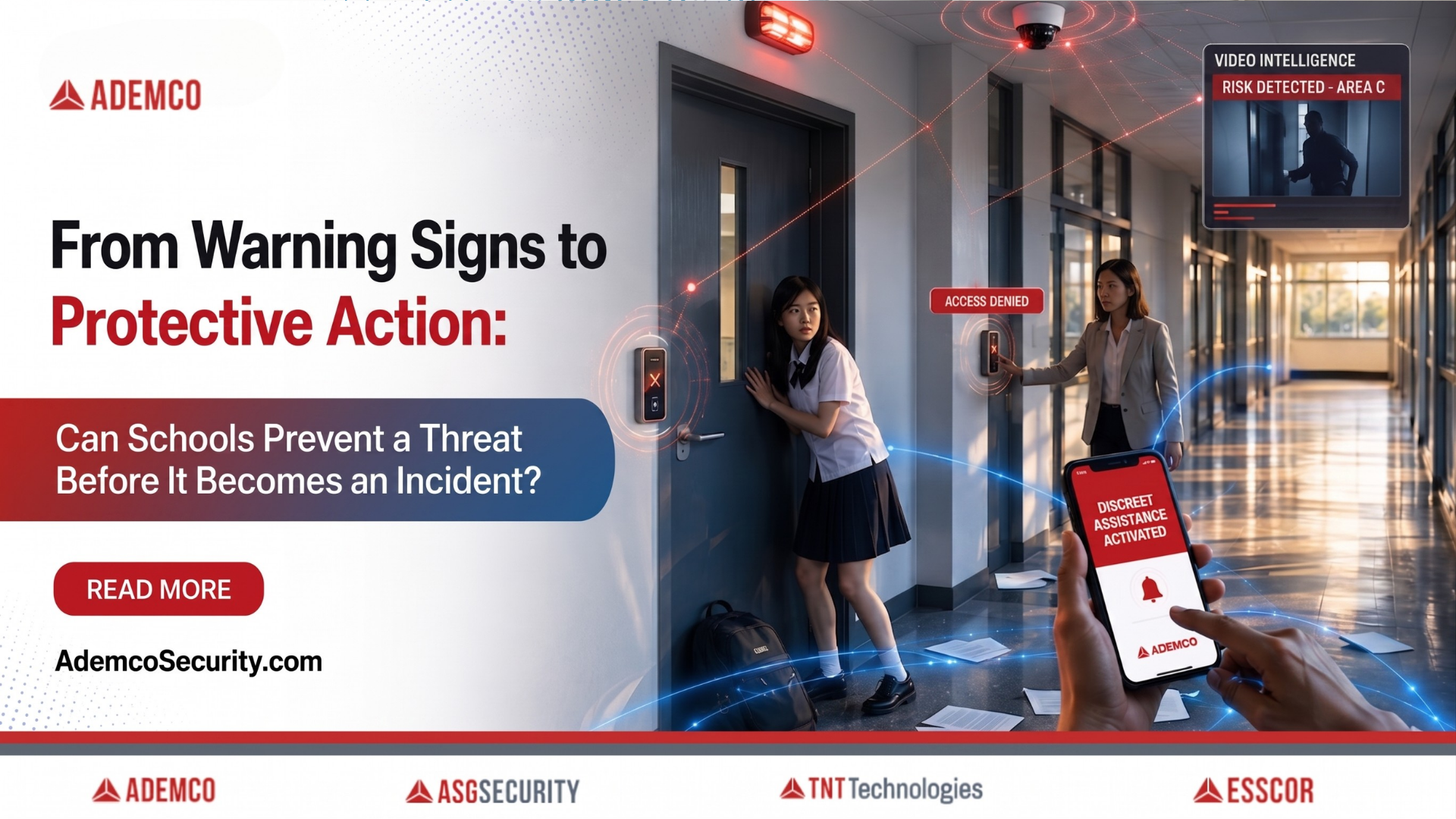
Video intelligence can detect events such as physical aggression, entry into restricted areas, crowd formation in designated locations or objects left in sensitive areas. Access control can identify forced doors, repeated denied-entry attempts, entry outside permitted hours and movement into unauthorised zones.
The effectiveness of these capabilities depends on context. Rapid movement into a closed building following repeated denied-access attempts presents a more meaningful risk than movement alone. Similarly, a possible aggression alert becomes more urgent when it coincides with a staff duress activation at the same location.
Connecting multiple signals helps schools distinguish credible risk conditions from everyday campus activity. Instead of overwhelming teams with every minor irregularity, alerts can be prioritised by severity, verified through relevant video and access information, and directed to the appropriate responder.
Detection rules should also reflect the school’s actual environment. Well-defined zones, operating schedules and thresholds—supported by regular performance reviews—can reduce nuisance alarms while maintaining sensitivity to meaningful events.
From detection to protective action
Whether a warning comes from a person or a system, the school must know what happens next. Who receives the alert? Can the situation be verified? Who decides whether intervention is necessary? Can access permissions or monitoring levels be adjusted quickly?
Effective school threat prevention requires a connected process:
Observe, detect, report, assess, protect, intervene and review.
Human awareness and technology should reinforce each other. Teachers, students and counsellors may notice behavioural or social warning signs that security systems cannot see. Technology can identify physical risk conditions across the campus and provide additional context for assessment.
Staff should also have a discreet way to request help when behaviour begins to escalate. A fixed panic button, mobile alert or other authorised duress mechanism becomes more effective when connected to the staff member’s location, nearby video and a predefined response procedure.
Intervention does not only mean responding after violence begins. It may involve verifying unusual activity, denying an unauthorised access attempt, sending assistance to a staff member or contacting the appropriate authorities while the situation is still developing.
How fragmented systems weaken prevention
Many schools already have multiple security systems, but these are often purchased separately, managed by different departments and supported by different stakeholders.
A panic alert may not be connected to video verification. Access permissions may remain active after a risk is identified. Behavioural concerns may stay within the counselling or teaching team without informing appropriate protective measures. After-hours alarms may be monitored without clear school-side escalation procedures.
Such fragmentation does more than create inconvenience. It can consume the limited time between recognising a warning sign and taking protective action.
School safety is not just a broken light.
Security technology sometimes falls under the facilities portfolio, but it would be a grave mistake to treat school safety like routine building maintenance. A faulty light can wait for a work order; a flawed or failing security system can mean developing threats go unnoticed. The consequences may not be one that we can bear.
School leadership, safeguarding teams, educators, counsellors, facilities, IT, security personnel and external authorities all have distinct but connected responsibilities. UNESCO similarly advocates a holistic approach involving the education sector and other stakeholders in creating safer learning environments. (UNESCO)
Building a coordinated school security capability
No security system can control every influence that reaches a student or guarantee that violence will never occur. Schools can, however, make it harder for harmful intent to become physical opportunity.
Ademco helps schools strengthen this protective layer by connecting access control, video intelligence, discreet assistance alerts, event verification, continuous monitoring and emergency accountability with wider safeguarding procedures.
As school threats evolve, the goal is no longer simply to secure the entrance. It is to shorten the distance between a warning sign and effective protective action.